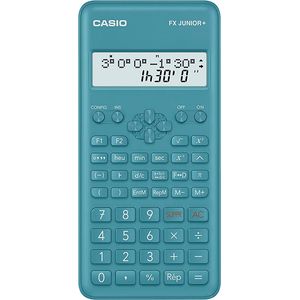
Discover our selection of scientific calculators for primary school, suitable for CM1 and CM2 students, including the Casio FX Junior+ CM1 CM2, ideal for learning basic calculations.
What is a primary scientific calculator and why does my child need one?
A primary scientific calculator is designed to support elementary school students in their math learning. It simplifies the understanding of complex operations, fractions, percentages, and basic geometry, thus helping your child build a strong foundation for future studies.
What are the essential features to look for in a primary scientific calculator?
For elementary school students, opt for models with a clear and readable display, intuitive buttons, and basic functions like addition, subtraction, multiplication, division, parentheses, simple fractions, and percentages. Durability is also an asset.
From what age do you recommend using a primary scientific calculator?
Usage can begin in elementary school, generally from the 3rd grade (equivalent to CE2/CM1), when students start tackling more advanced mathematical concepts and the calculator can serve as a pedagogical tool to verify their calculations and understand new concepts.
What is the difference between a primary scientific calculator and a graphing calculator?
A primary scientific calculator is intended for basic and intermediate calculations without graphical visualization. A graphing calculator, more advanced, allows for plotting curves, solving complex equations, and is generally used in middle and high school.
Where can I find reliable scientific calculators that are suitable for the Moroccan school curriculum?
On our e-commerce site, you will find a selection of scientific calculators from recognized brands, chosen for their reliability and suitability for the needs of elementary school students in Morocco. We ensure we offer models that facilitate learning.
How can I help my child use their primary scientific calculator effectively?
Encourage your child to use the calculator as a tool to verify their manual calculations. Show them how to correctly enter operations and fractions. The goal is to strengthen their understanding of mathematics, not to replace their reasoning.