A Moroccan school supply list usually gives each notebook a single line: 24x32 notebook, 96 pages, large squares, red cover. Every word in that line is a separate requirement, and when one is misread the teacher asks for a new notebook. This guide explains how to read those lines, format by format, and what to check on the label before packing the school bag.
The three formats on school lists
Primary and middle school lists almost always name three formats. They are not interchangeable: notebook covers, glued-in handouts and sometimes classroom storage all depend on the size.
The 24x32 large format
A 24x32 notebook measures 24 cm by 32 cm, larger than an A4 sheet (21 x 29.7 cm). That is the point of it: an A4 photocopy can be glued in flat, with a margin all round, without folding. Teachers ask for it in subjects where many handouts are glued in, such as French, Arabic or science discovery.
The A4 format
An A4 notebook is 21 x 29.7 cm, the size of printer paper. An A4 sheet glued inside sticks out, so it has to be trimmed or folded. A4 is common from middle school onwards, and labels often call it large format (grand format). If the list says 24x32, an A4 notebook will not do, even if it is sold as large format.
The small format, often labelled A5
The small format notebook is the everyday one. Check the real size: school notebooks sold as A5 usually measure 17 x 22 cm, slightly more than standard A5 (14.8 x 21 cm). Keep that 17x22 size in mind when you choose the cover.
Page count: 48, 96, 140, 192, 288
The number printed on a notebook counts pages, not sheets. A 96-page notebook therefore holds 48 sheets. This avoids a common mistake when a list talks about sheets.
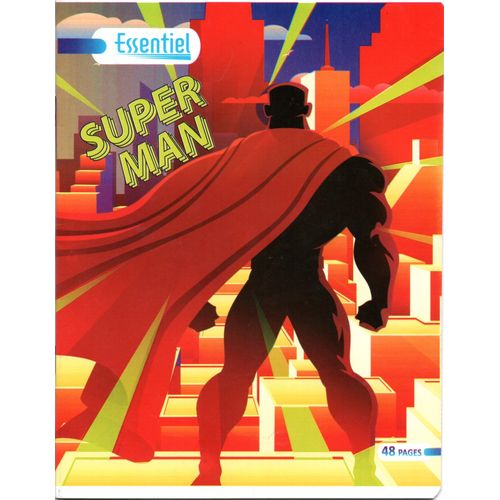
- 48 pages: a thin notebook for a subject taught one or two hours a week, or a home-school liaison book. Example: the Essentiel 48-page small format notebook.
- 96 pages: the most requested thickness, for a main subject over a term or more.
- 140 and 192 pages: to last the whole year in a dense subject, or as a rough book.
- 288 and 384 pages: thick notebooks, usually perfect-bound, to group several lessons or serve as a rough book for the whole year.
The binding follows the thickness. Up to 192 pages, notebooks are usually stapled (piqué) through the middle. Beyond that they are perfect-bound (broché) with a flat spine, like the Essentiel 288-page bound notebook. A stapled notebook opens flat easily, a bound one holds up better when it is thick. Spiral notebooks fold back on themselves and are mostly used in middle and high school.
Seyès large squares or small squares
Seyès ruling, called large squares (grands carreaux), is the classic school ruling. It forms 8 mm squares, each split by three fine lines 2 mm apart. These lines guide letter height, which is why primary schools require it for learning handwriting in French.
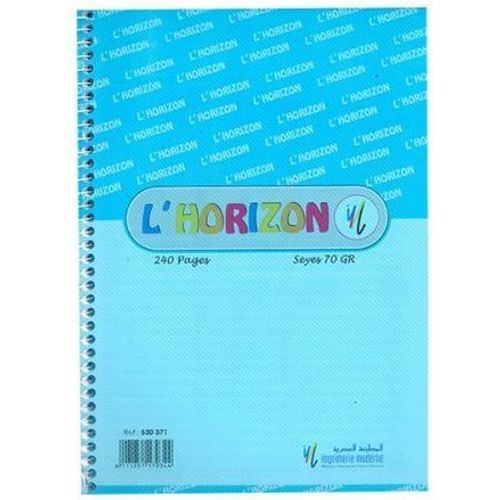
Small squares (petits carreaux) are plain 5 mm squares, with no intermediate lines. They suit maths, physics and diagrams, where pupils draw tables and figures. They are mostly found in large format from middle school onwards, for example the L’Horizon 240-page small squares spiral notebook.
If the list does not state the ruling, large squares are generally expected. When in doubt, ask the teacher before buying several notebooks.
Paper weight
Paper weight, written in g/m², tells you how heavy the paper is and gives an idea of its thickness. The higher it is, the less ink shows through.
- 60 g/m²: light paper, common on everyday notebooks. Fine for ballpoint and pencil. Felt-tip pens and highlighters may show on the back.
- 70 to 72 g/m²: a little firmer, it copes better with a fountain pen.
- 90 g/m²: thick paper, writing barely shows on the other side. Worth it for pupils who write in ink or colour a lot.
A 96-page notebook in 90 g/m² is thicker and heavier than a 96-page one in 60 g/m². In a primary school bag holding six or seven notebooks, the difference is noticeable.
Polypro or card cover
The card cover is the classic version. It is thin and gets creased quickly in the bag, so it nearly always needs a protective cover.
Polypro notebooks have a polypropylene cover, a flexible plastic that resists water and does not dog-ear. They come in several colours, so you can keep a colour code per subject without a separate cover. Many lists still require a cover of a set colour on every notebook, and in that case polypro adds nothing. Check the list before buying.
The TP notebook
A TP notebook (travaux pratiques, practical work) alternates a ruled page and a blank page for drawings, diagrams and maps. It is requested for science, life and earth sciences or geography. TP notebooks come in small format and A4. When the label shows two paper weights, such as 60/90 g/m², the heavier one is for the drawing pages, which take coloured pencils and glue.
The cover must match the format
Choose the protective cover by notebook size, not by page count. A cover that is too big slides off, one that is too small will not close. On a thick notebook (192 or 288 pages), pick a flexible cover with a little slack.
| Notebook format | Size | Cover to buy | Usual use |
|---|---|---|---|
| Small format (A5) | 17 x 22 cm | small format A5 notebook cover | Primary school subjects, daily notebook |
| A4 | 21 x 29.7 cm | A4 notebook cover | Middle and high school |
| 24x32 | 24 x 32 cm | 24x32 notebook cover | Subjects with glued-in handouts |
Lists often tie a colour to a subject, for example red for one language and green for another. Write the colour next to each line of the list before you shop. It is the most common mistake on the first day of school.
Our advice
- Primary school: 17x22 small format with large squares, 48 or 96 pages depending on the subject, plus one or two 24x32 notebooks for glued handouts. Paper of 70 g/m² or more if the child writes with a fountain pen.
- Middle school: A4 or 24x32 as the list says, 96 to 192 pages. Small squares for maths if the teacher asks, and a TP notebook for science.
- High school: large format spiral notebook of 240 or 300 pages to hold several chapters, with small squares for science subjects.
- A pupil who wears notebooks out: a polypro notebook, if the list does not require a coloured cover.
Before buying, read each line of the list in this order: format, page count, ruling, cover colour. The full range is in the stylo.ma school notebooks category.