A whiteboard marker and a permanent marker look alike in a pencil case, but their ink does opposite jobs. One has to come off with a wipe, the other has to stay on a carton, a tarp or a plastic bag. Pick the wrong one and you get a stained board or a label that rubs off. This guide covers the ink type, the tip shape, and how to make markers last.
Dry erase or permanent: the difference is the ink
The ink in a whiteboard marker, also called dry erase, contains a release agent. It sits on the smooth surface without bonding to it, then lifts off with an eraser or a dry cloth. It does write on paper, but the line is pale and will not erase there. The whiteboard markers section groups these models.
The ink in a permanent marker contains a resin that grips the surface as it dries. It resists water and holds on paper, cardboard, plastic, metal, glass, and for some models wood or fabric. It is the tool for labelling a moving box, a storage tub, a cable or a CD. The shop lists them under permanent markers.
Read the barrel: erasable, dry erase or whiteboard on one side, permanent or indelible on the other. Keeping the two families in separate pots prevents most accidents.
Bullet, chisel or fine tip
A bullet tip, or round tip, gives the same line width whatever the angle of the hand. It is sturdy and forgives an awkward grip. It is the usual shape in classrooms and meeting rooms. The Deli THINK U001 wallet with a 2 mm bullet tip is one example, in black, blue, red and green. The widest choice is in bullet tip whiteboard markers.
A chisel tip is cut at an angle. Held on its edge it draws a thin line. Laid flat it draws a wide one, for a heading or an underline that can be read from the back of the room. The Deli Mate U004 pack gives a 2 to 5 mm line from the same tip. Among permanents, the Monami Highper-C black also has a chisel tip, handy for big letters on a carton.

A fine tip is for small surfaces: a pupil’s whiteboard slate, a wall planner, a kitchen board. The BIC Velleda fine tip wallet of 5 colours is made for that size. On a full classroom board, a fine line is hard to read past the first rows.
Reading the line width
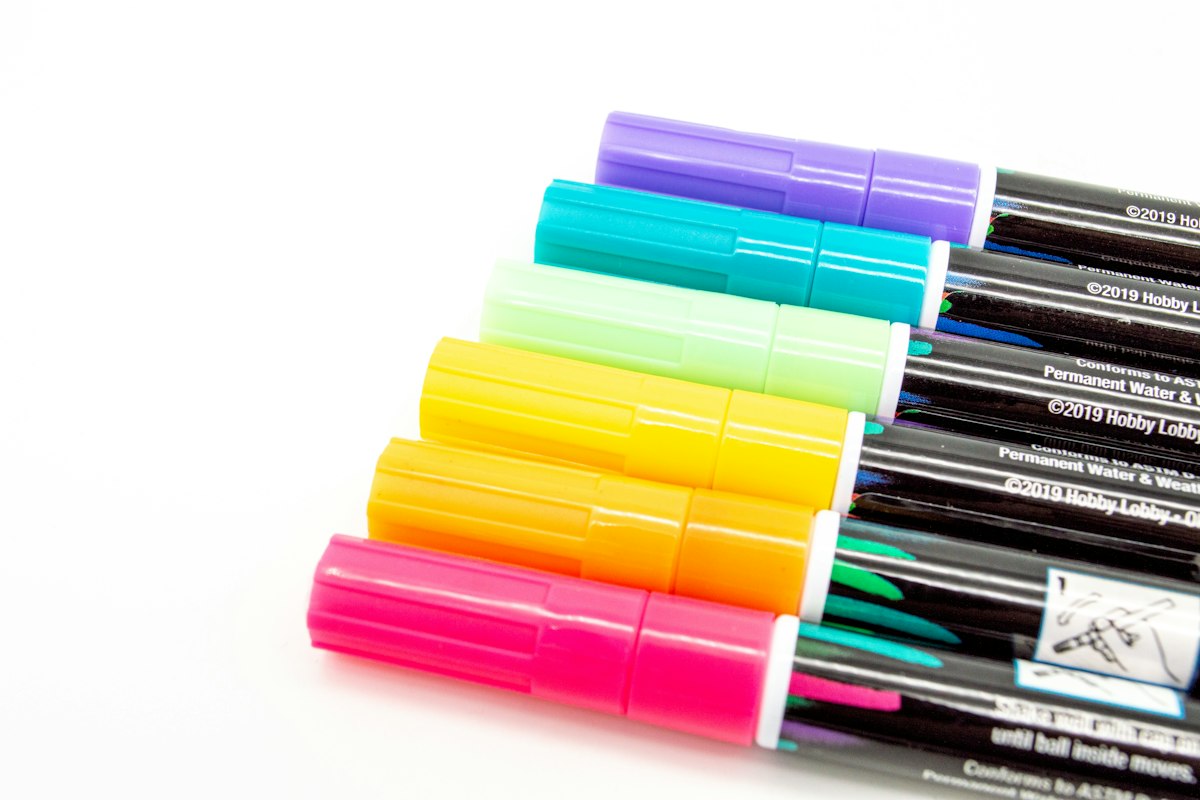
The figure in millimetres is the width of the line, not of the barrel. A permanent bullet tip of 1.5 mm, such as the Deli THINK U100 black, writes an address on a parcel legibly. A 2 mm bullet tip suits everyday writing on a board. A chisel that reaches 5 mm is for headings. For a chisel tip, makers often give two figures: the line on the edge and the line flat.
| Tip | Line | Where it wins | Limit |
|---|---|---|---|
| Bullet | Even, about 1.5 to 2 mm | Everyday board writing, labelling | No wide stroke for headings |
| Chisel | Thin on the edge, wide flat | Headings, diagrams, cartons | You must hold the same angle |
| Fine | Thin | Slate, planner, small board | Hard to read from afar |
Which surface for which marker
A dry erase marker is for smooth, non-porous surfaces: whiteboard, pupil slate, glass, mirror, laminated plastic. On a melamine board, ink left for several days ends up leaving a grey shadow. Enamel and glass boards wipe cleaner. Erasing at the end of each day keeps the surface clear.
A permanent marker is for anything that must keep the writing. On thin paper the ink can bleed through, so slide a piece of card underneath. On fabric, plastic or glass, test in a corner before writing large, because the result depends on the material.
Permanent marker on a whiteboard: how to remove it
Permanent ink grips the smooth coating of the board. The eraser will not move it, and scrubbing hard with an abrasive sponge scratches the surface. A scratched surface then holds on to dry erase ink and the board stains more and more.
The method that works most often:
- Draw over the permanent line with a whiteboard marker, covering all of it.
- Let it dry for a few seconds. The solvents in the dry erase ink soften the permanent ink.
- Wipe with a dry cloth. Repeat if a trace remains.
- For a stubborn residue, use a soft cloth lightly dampened with alcohol, then wipe dry.
Avoid acetone and abrasive cleaners, which can dull some coatings. If the board maker recommends a cleaner, use that one.

Refillable markers and ink cartridges
A refillable marker keeps its barrel and tip, and you replace only the ink. For a school or an office that empties whole boxes of markers each term, it cuts the number of barrels thrown away. The Deli Whiteboard Marker 6820, in four colours, is one refillable model in the shop.
Refills are in the marker ink section, as single cartridges or packs of 24. Before buying, check that the cartridge is made for your marker model, because formats are not universal. A dry erase refill never goes into a permanent marker, and the reverse is just as true.
Keeping markers from drying out
- Recap straight away, until it clicks. A marker left open through a meeting can dry out quickly.
- Store them flat, so the ink stays spread between the reservoir and the tip.
- Keep them away from heat: a car in summer or a sunny window sill speeds up evaporation.
- Do not crush the tip: pressing hard pushes the fibre in and the line turns uneven.
- Rotate your stock: when buying by the box, use the oldest markers first.
Our advice
- Classroom or meeting room: bullet tip whiteboard markers in four colours, plus one chisel tip for headings. In boxes, such as the Staedtler Lumocolor 351 black, box of 10, black and blue run out first.
- Pupil’s slate: a fine tip. The mini marker with eraser keeps pen and wiper together in the school bag.
- Cartons, labels, tools: a 1.5 mm bullet tip permanent for small writing, a chisel tip for big letters.
- Heavy use: refillable markers and cartridges of the right reference.
- For writing on paper, a marker is the wrong tool. The guide ballpoint, gel, rollerball or fountain pen helps you choose a pen.