Classic cartable, backpack or rolling cartable: the right choice depends on three things. The child’s age, the weight carried every day and the route between home and the classroom. A fourth point is often forgotten in the shop: the 24x32 notebook on school supply lists must fit flat, without bending.
Three formats, three uses
The classic cartable is rectangular with a rigid base. It keeps notebooks straight and stands on its own by the desk. It is worn on the back with two straps. Its drawback: it weighs more empty than a soft bag.
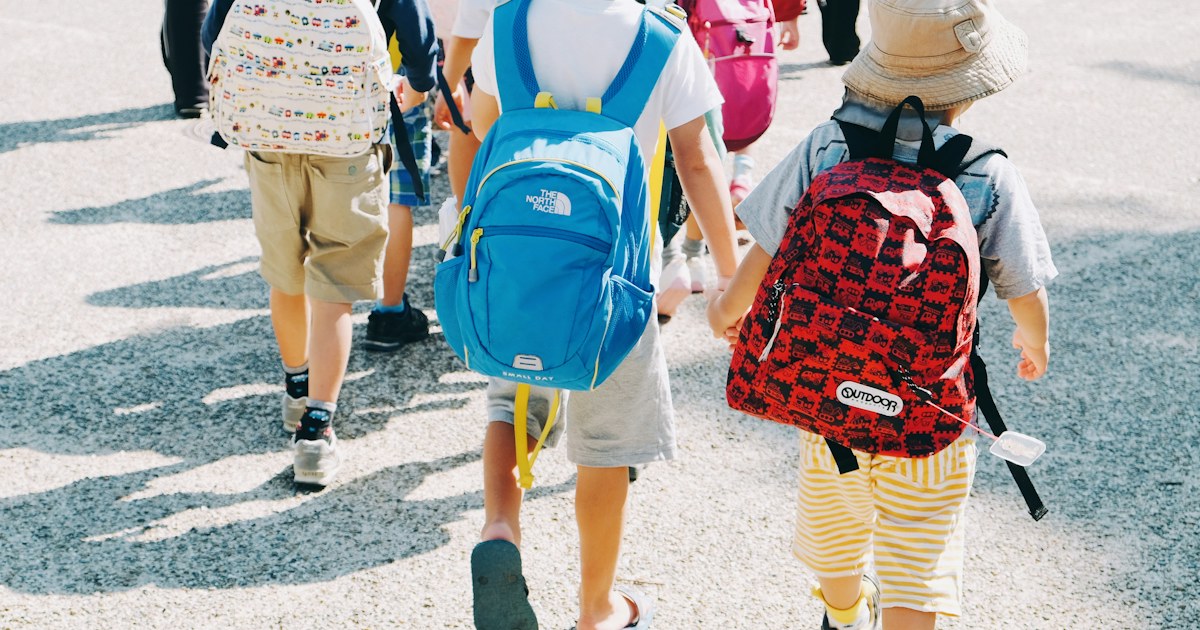
The school backpack is soft and lighter. It follows the child from primary school to high school. It is the most common format in our school backpacks section, with volumes around 24 to 25 litres.
The rolling cartable adds a telescopic handle and two wheels. The child pulls the load instead of carrying it. The trade-off: the frame and wheels make the bag heavier whenever it has to be lifted.
| Criterion | Classic cartable | Backpack | Rolling cartable |
|---|---|---|---|
| Empty weight | Medium | Lightest | Heaviest |
| Notebook protection | Good, rigid base | Fair if packed well | Good, rigid structure |
| Stairs, school bus | No problem | No problem | Awkward, must be carried |
| Heavy load, flat route | Tires the back | Tires the back | Its real strength |
| Most common level | Primary | Late primary, middle school, high school | Primary |
Which bag for which age and school level
Preschool
A small backpack is enough. It carries a snack, a water bottle and sometimes a home-school notebook. A large empty cartable serves no purpose at this age and only gets in the way.
Primary school
This is when 24x32 notebooks and textbooks pile up. The classic cartable and the rolling cartable are the two most chosen formats. Wheels make sense if the route is mostly flat and the classroom is on the ground floor. With several flights of stairs a day, a well-adjusted backpack is more practical. Our rolling cartables section gathers the models with a telescopic handle.
Middle and high school
The backpack takes over. Pupils change rooms several times a day and climb stairs. A volume of 24 to 25 litres holds the day’s notebooks, a pencil case and a bottle. In high school, a padded laptop sleeve becomes useful: the Eastpak Day Pak’r backpack takes a laptop up to 14 inches.
The 24x32 notebook test
In Morocco, school supply lists mostly ask for 24x32 and A5 notebooks. A 24x32 notebook is 24 cm wide and 32 cm tall. With a plastic cover it gains a few millimetres. The main compartment therefore needs more than 32 cm of usable height and more than 24 cm of width.
Listed dimensions are external. Padding and seams take some room. A bag 40 cm tall and 30 cm wide, like the TeenPack 24 L backpack, leaves the margin needed. The Woot 25 L backpack lists 43 × 32 × 20 cm. The simplest check is to try a real 24x32 notebook: it must go in flat and the zip must close without forcing.

A bag that is too narrow bends notebook corners within the first week. A bag that is too big invites carrying everything and becomes heavy.
Straps and back panel: what to check
- Wide, padded straps. A thin strap twists and digs into the shoulder. Check that the foam runs down the full length of the strap.
- Easy adjustment. Children grow during the year. Buckles should slide without tools.
- Padded back. It keeps book corners from pressing on the spine. TeenPack models have a reinforced back panel, Woot models a padded back.
- Carrying height. Once adjusted, the top of the bag stays below the shoulders and the bottom sits at the waist, not on the buttocks.
- Two straps, always. Carrying the bag on one shoulder makes the body lean to one side.
Weight: one guideline and two simple tests
A guideline widely used in paediatrics: a loaded bag should not exceed about 10% of the child’s body weight. It is an order of magnitude, not a strict rule. Weigh the full bag once at the start of the year on a bathroom scale.
Two signs show the load is too heavy: the child leans clearly forward to walk, or comes home with red marks on the shoulders. In that case, lighten the contents before changing the bag.
Empty weight matters too. A bag that is already heavy with nothing inside leaves less margin for notebooks. Compare models empty by lifting them with one hand.

Packing the bag well
- Follow the timetable: carry only the next day’s notebooks and textbooks.
- Put the heaviest items, textbooks and thick notebooks, against the back.
- Stand notebooks upright, flat against each other, so they do not slide.
- Keep the pencil case and small items in the front pocket.
- Keep the water bottle in a side pocket, away from notebooks.
- Empty the bag at the end of the week: forgotten sheets, snacks and toys add weight unnoticed.
3-piece sets
A 3-piece set combines a rolling cartable, a lunch bag and a pencil case in matching designs. The lunch bag keeps food away from notebooks, which avoids juice or butter stains on homework. The matching pencil case helps younger children recognise their things in class.
The Woot 3-piece Football rolling cartable follows this idea with a telescopic handle and padded straps. Other designs are in the 3-piece rolling cartables section.

Materials and waterproofing
Most school bags are made of polyester or polyamide (nylon). These fabrics resist abrasion well and clean with a damp sponge. The word waterproof refers to the fabric. Water mostly gets in through zips and seams.
For rainy days, look at the zips. The Gabol Skull rolling backpack has zips hidden under a flap and a 92 cm telescopic handle. The Gabol range also comes without wheels, like the Gabol Score 3-compartment backpack.
For walks home at dusk in winter, a reflective print helps the child be seen. The Eastpak Padded Double Refleks has one, along with a laptop sleeve up to 13 inches.
Our advice
- Preschool: a small light backpack with a bottle pocket.
- Primary, flat route, few stairs: a rolling cartable, as a 3-piece set if the child takes a packed snack.
- Primary, stairs or school bus: a cartable or a backpack with a padded back that takes a 24x32 notebook flat.
- Middle school: a 24 to 25 litre backpack with two compartments, to separate notebooks and pencil case.
- High school: a backpack with a padded laptop sleeve.
- Rainy area: a waterproof model with covered zips.
In every case, do the 24x32 notebook test and adjust the straps on the child, with the bag loaded.